 Add to Chrome
 Add to Firefox
 Add to Edge
Brain-Atlas-Guided Generative Counterfactual Attention for Explainable Cognitive Decline Diagnosis Using Multimodal Connectomes
May 31, 2026
Mild cognitive impairment (MCI) and subjective cognitive decline (SCD) are closely associated with the early Alzheimer's disease continuum, where accurate and explainable diagnosis is important for early risk assessment and intervention. Existing connectome-based deep learning models can improve classification performance but often provide limited insight into disease-related functional and structural connectivity changes. This paper proposes an atlas-knowledge-guided Generative Counterfactual Attention-guided Network (GCAN) for explainable cognitive decline diagnosis using multimodal brain connectomes. GCAN formulates diagnosis as a source-to-target counterfactual generation problem, where target-label connectomes are generated from source-label inputs and their differences are used to construct counterfactual attention maps. To preserve connectome topology, an Atlas-aware Bidirectional Transformer (AABT) performs network-level token encoding and decoding under brain-atlas constraints. The framework is further extended from functional connectivity (FC) to joint functional and structural connectivity (SC) modeling, enabling counterfactual analysis of complementary functional reorganization and structural topology changes. Experiments on hospital-collected and ADNI datasets show that GCAN achieves competitive performance across HC vs. SCD, HC vs. MCI, and SCD vs. MCI classification tasks. Visualization, circular connectome analysis, CAM-based comparison, ablation studies, and confidence interval analysis further support the interpretability and reliability of the proposed framework. Modality-specific FC and SC pre-trained classifiers are used to provide target-state priors for counterfactual generation while being separated from the downstream diagnostic classifier to prevent data leakage.

STAMBRIDGE: Spectral-Temporal Amplitude-aware Mid-Feature Bridge for EEG Visual Decoding
May 27, 2026Electroencephalography (EEG) visual decoding remains challenging due to the modality gap between low-SNR neural signals and highly structured vision--language spaces, making direct cross-modal alignment unstable. To address this, we propose STAMBRIDGE, a versatile two-stage framework that sequentially tackles feature conditioning and cross-modal alignment. First, we introduce a Spectral-Temporal Amplitude-aware Modulation (STAM) to extract well-conditioned EEG representations. By replacing hard frequency masking with amplitude-derived soft channel weighting and multi-scale temporal convolutions, STAM explicitly preserves frequency-aware transients while reducing the risk of time-domain ringing artifacts. Building upon these robust neural features, we further introduce a model-agnostic Mid-Feature Semantic Bridge (MFSB) that constructs a regularized intermediate space through directed cross-modal interactions, enabling staged distillation and more stable semantic alignment. Experiments on the THINGS-EEG benchmark show competitive 200-way zero-shot retrieval performance, with 34.50\% Top-1 and 65.95\% Top-5 accuracy. In addition, embeddings learned by STAMBRIDGE produce semantically coherent image reconstructions with a diffusion model, demonstrating robust EEG-to-vision semantic alignment. The code is available at: https://github.com/thabeatmjh/STAMBRIDGE.
Region-aware Spatiotemporal Modeling with Collaborative Domain Generalization for Cross-Subject EEG Emotion Recognition
Jan 22, 2026Cross-subject EEG-based emotion recognition (EER) remains challenging due to strong inter-subject variability, which induces substantial distribution shifts in EEG signals, as well as the high complexity of emotion-related neural representations in both spatial organization and temporal evolution. Existing approaches typically improve spatial modeling, temporal modeling, or generalization strategies in isolation, which limits their ability to align representations across subjects while capturing multi-scale dynamics and suppressing subject-specific bias within a unified framework. To address these gaps, we propose a Region-aware Spatiotemporal Modeling framework with Collaborative Domain Generalization (RSM-CoDG) for cross-subject EEG emotion recognition. RSM-CoDG incorporates neuroscience priors derived from functional brain region partitioning to construct region-level spatial representations, thereby improving cross-subject comparability. It also employs multi-scale temporal modeling to characterize the dynamic evolution of emotion-evoked neural activity. In addition, the framework employs a collaborative domain generalization strategy, incorporating multidimensional constraints to reduce subject-specific bias in a fully unseen target subject setting, which enhances the generalization to unknown individuals. Extensive experimental results on SEED series datasets demonstrate that RSM-CoDG consistently outperforms existing competing methods, providing an effective approach for improving robustness. The source code is available at https://github.com/RyanLi-X/RSM-CoDG.
SpikCommander: A High-performance Spiking Transformer with Multi-view Learning for Efficient Speech Command Recognition
Nov 13, 2025Spiking neural networks (SNNs) offer a promising path toward energy-efficient speech command recognition (SCR) by leveraging their event-driven processing paradigm. However, existing SNN-based SCR methods often struggle to capture rich temporal dependencies and contextual information from speech due to limited temporal modeling and binary spike-based representations. To address these challenges, we first introduce the multi-view spiking temporal-aware self-attention (MSTASA) module, which combines effective spiking temporal-aware attention with a multi-view learning framework to model complementary temporal dependencies in speech commands. Building on MSTASA, we further propose SpikCommander, a fully spike-driven transformer architecture that integrates MSTASA with a spiking contextual refinement channel MLP (SCR-MLP) to jointly enhance temporal context modeling and channel-wise feature integration. We evaluate our method on three benchmark datasets: the Spiking Heidelberg Dataset (SHD), the Spiking Speech Commands (SSC), and the Google Speech Commands V2 (GSC). Extensive experiments demonstrate that SpikCommander consistently outperforms state-of-the-art (SOTA) SNN approaches with fewer parameters under comparable time steps, highlighting its effectiveness and efficiency for robust speech command recognition.
BrainCSD: A Hierarchical Consistency-Driven MoE Foundation Model for Unified Connectome Synthesis and Multitask Brain Trait Prediction
Nov 07, 2025Functional and structural connectivity (FC/SC) are key multimodal biomarkers for brain analysis, yet their clinical utility is hindered by costly acquisition, complex preprocessing, and frequent missing modalities. Existing foundation models either process single modalities or lack explicit mechanisms for cross-modal and cross-scale consistency. We propose BrainCSD, a hierarchical mixture-of-experts (MoE) foundation model that jointly synthesizes FC/SC biomarkers and supports downstream decoding tasks (diagnosis and prediction). BrainCSD features three neuroanatomically grounded components: (1) a ROI-specific MoE that aligns regional activations from canonical networks (e.g., DMN, FPN) with a global atlas via contrastive consistency; (2) a Encoding-Activation MOE that models dynamic cross-time/gradient dependencies in fMRI/dMRI; and (3) a network-aware refinement MoE that enforces structural priors and symmetry at individual and population levels. Evaluated on the datasets under complete and missing-modality settings, BrainCSD achieves SOTA results: 95.6\% accuracy for MCI vs. CN classification without FC, low synthesis error (FC RMSE: 0.038; SC RMSE: 0.006), brain age prediction (MAE: 4.04 years), and MMSE score estimation (MAE: 1.72 points). Code is available in \href{https://github.com/SXR3015/BrainCSD}{BrainCSD}
Pattern-Aware Diffusion Synthesis of fMRI/dMRI with Tissue and Microstructural Refinement
Nov 07, 2025Magnetic resonance imaging (MRI), especially functional MRI (fMRI) and diffusion MRI (dMRI), is essential for studying neurodegenerative diseases. However, missing modalities pose a major barrier to their clinical use. Although GAN- and diffusion model-based approaches have shown some promise in modality completion, they remain limited in fMRI-dMRI synthesis due to (1) significant BOLD vs. diffusion-weighted signal differences between fMRI and dMRI in time/gradient axis, and (2) inadequate integration of disease-related neuroanatomical patterns during generation. To address these challenges, we propose PDS, introducing two key innovations: (1) a pattern-aware dual-modal 3D diffusion framework for cross-modality learning, and (2) a tissue refinement network integrated with a efficient microstructure refinement to maintain structural fidelity and fine details. Evaluated on OASIS-3, ADNI, and in-house datasets, our method achieves state-of-the-art results, with PSNR/SSIM scores of 29.83 dB/90.84\% for fMRI synthesis (+1.54 dB/+4.12\% over baselines) and 30.00 dB/77.55\% for dMRI synthesis (+1.02 dB/+2.2\%). In clinical validation, the synthesized data show strong diagnostic performance, achieving 67.92\%/66.02\%/64.15\% accuracy (NC vs. MCI vs. AD) in hybrid real-synthetic experiments. Code is available in \href{https://github.com/SXR3015/PDS}{PDS GitHub Repository}
S$^2$M-Former: Spiking Symmetric Mixing Branchformer for Brain Auditory Attention Detection
Aug 07, 2025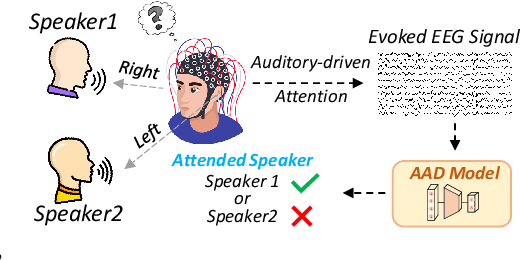

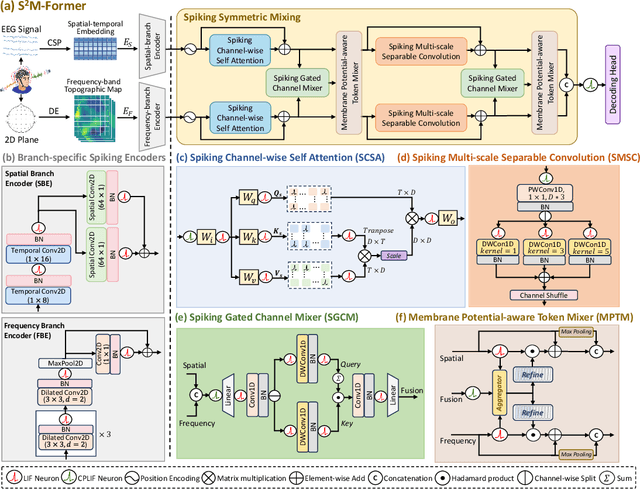
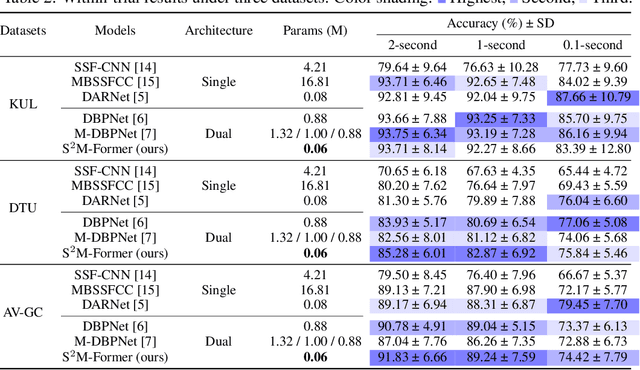
Auditory attention detection (AAD) aims to decode listeners' focus in complex auditory environments from electroencephalography (EEG) recordings, which is crucial for developing neuro-steered hearing devices. Despite recent advancements, EEG-based AAD remains hindered by the absence of synergistic frameworks that can fully leverage complementary EEG features under energy-efficiency constraints. We propose S$^2$M-Former, a novel spiking symmetric mixing framework to address this limitation through two key innovations: i) Presenting a spike-driven symmetric architecture composed of parallel spatial and frequency branches with mirrored modular design, leveraging biologically plausible token-channel mixers to enhance complementary learning across branches; ii) Introducing lightweight 1D token sequences to replace conventional 3D operations, reducing parameters by 14.7$\times$. The brain-inspired spiking architecture further reduces power consumption, achieving a 5.8$\times$ energy reduction compared to recent ANN methods, while also surpassing existing SNN baselines in terms of parameter efficiency and performance. Comprehensive experiments on three AAD benchmarks (KUL, DTU and AV-GC-AAD) across three settings (within-trial, cross-trial and cross-subject) demonstrate that S$^2$M-Former achieves comparable state-of-the-art (SOTA) decoding accuracy, making it a promising low-power, high-performance solution for AAD tasks.
Optimizing Multi-DNN Inference on Mobile Devices through Heterogeneous Processor Co-Execution
Mar 27, 2025Deep Neural Networks (DNNs) are increasingly deployed across diverse industries, driving demand for mobile device support. However, existing mobile inference frameworks often rely on a single processor per model, limiting hardware utilization and causing suboptimal performance and energy efficiency. Expanding DNN accessibility on mobile platforms requires adaptive, resource-efficient solutions to meet rising computational needs without compromising functionality. Parallel inference of multiple DNNs on heterogeneous processors remains challenging. Some works partition DNN operations into subgraphs for parallel execution across processors, but these often create excessive subgraphs based only on hardware compatibility, increasing scheduling complexity and memory overhead. To address this, we propose an Advanced Multi-DNN Model Scheduling (ADMS) strategy for optimizing multi-DNN inference on mobile heterogeneous processors. ADMS constructs an optimal subgraph partitioning strategy offline, balancing hardware operation support and scheduling granularity, and uses a processor-state-aware algorithm to dynamically adjust workloads based on real-time conditions. This ensures efficient workload distribution and maximizes processor utilization. Experiments show ADMS reduces multi-DNN inference latency by 4.04 times compared to vanilla frameworks.
Anti-Degeneracy Scheme for Lidar SLAM based on Particle Filter in Geometry Feature-Less Environments
Feb 17, 2025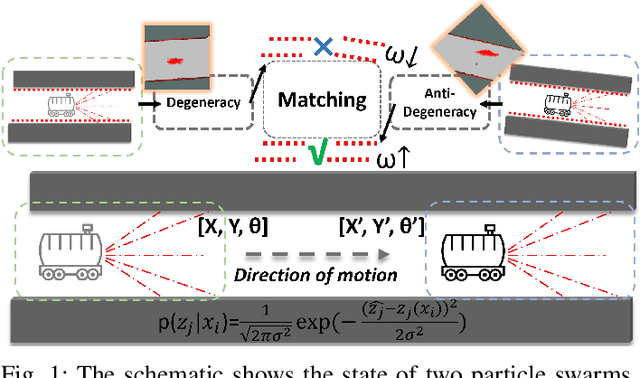
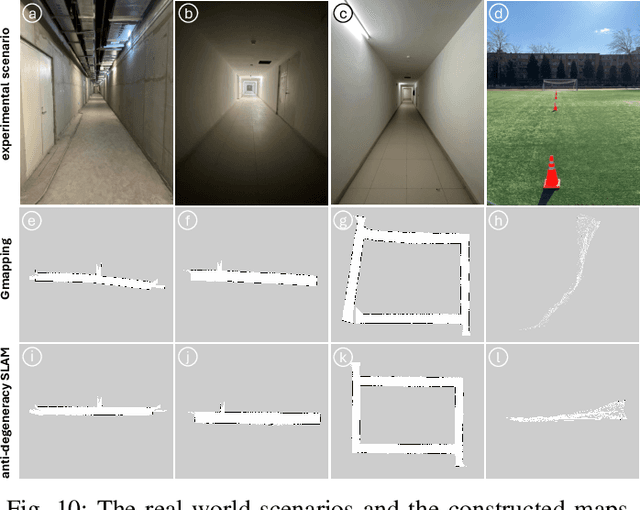
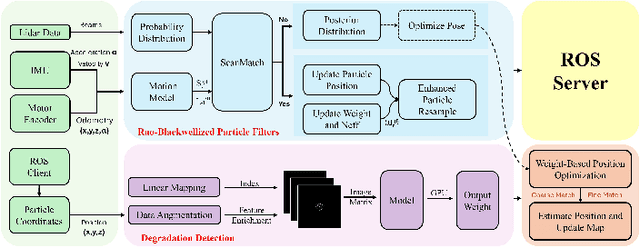
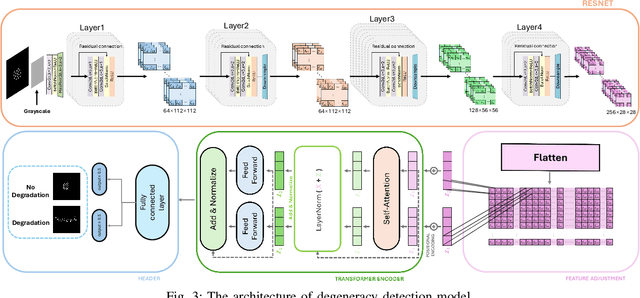
Simultaneous localization and mapping (SLAM) based on particle filtering has been extensively employed in indoor scenarios due to its high efficiency. However, in geometry feature-less scenes, the accuracy is severely reduced due to lack of constraints. In this article, we propose an anti-degeneracy system based on deep learning. Firstly, we design a scale-invariant linear mapping to convert coordinates in continuous space into discrete indexes, in which a data augmentation method based on Gaussian model is proposed to ensure the model performance by effectively mitigating the impact of changes in the number of particles on the feature distribution. Secondly, we develop a degeneracy detection model using residual neural networks (ResNet) and transformer which is able to identify degeneracy by scrutinizing the distribution of the particle population. Thirdly, an adaptive anti-degeneracy strategy is designed, which first performs fusion and perturbation on the resample process to provide rich and accurate initial values for the pose optimization, and use a hierarchical pose optimization combining coarse and fine matching, which is able to adaptively adjust the optimization frequency and the sensor trustworthiness according to the degree of degeneracy, in order to enhance the ability of searching the global optimal pose. Finally, we demonstrate the optimality of the model, as well as the improvement of the image matrix method and GPU on the computation time through ablation experiments, and verify the performance of the anti-degeneracy system in different scenarios through simulation experiments and real experiments. This work has been submitted to IEEE for publication. Copyright may be transferred without notice, after which this version may no longer be available.
EEG-ReMinD: Enhancing Neurodegenerative EEG Decoding through Self-Supervised State Reconstruction-Primed Riemannian Dynamics
Jan 14, 2025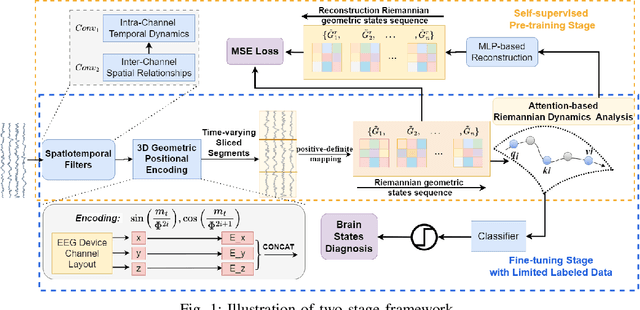


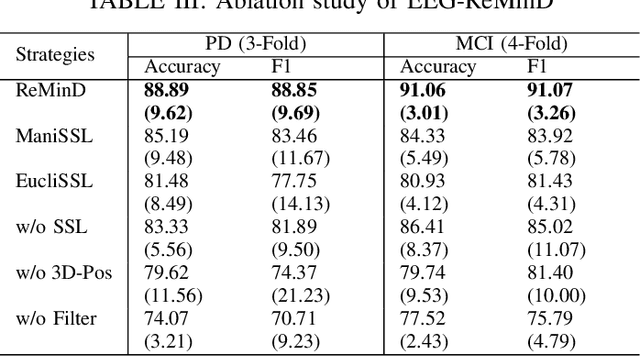
The development of EEG decoding algorithms confronts challenges such as data sparsity, subject variability, and the need for precise annotations, all of which are vital for advancing brain-computer interfaces and enhancing the diagnosis of diseases. To address these issues, we propose a novel two-stage approach named Self-Supervised State Reconstruction-Primed Riemannian Dynamics (EEG-ReMinD) , which mitigates reliance on supervised learning and integrates inherent geometric features. This approach efficiently handles EEG data corruptions and reduces the dependency on labels. EEG-ReMinD utilizes self-supervised and geometric learning techniques, along with an attention mechanism, to analyze the temporal dynamics of EEG features within the framework of Riemannian geometry, referred to as Riemannian dynamics. Comparative analyses on both intact and corrupted datasets from two different neurodegenerative disorders underscore the enhanced performance of EEG-ReMinD.